How to Spot AI-Generated Content Even When It’s Good
AI-generated content is becoming increasingly difficult to recognize. Early AI writing often sounded repetitive, overly formal, or strangely unnatural. Today, advanced tools can create articles, emails, social media posts, images, videos, and even realistic voices in seconds. The results can be polished enough to appear completely human at first glance.
By Helen Johns on July 13, 2026
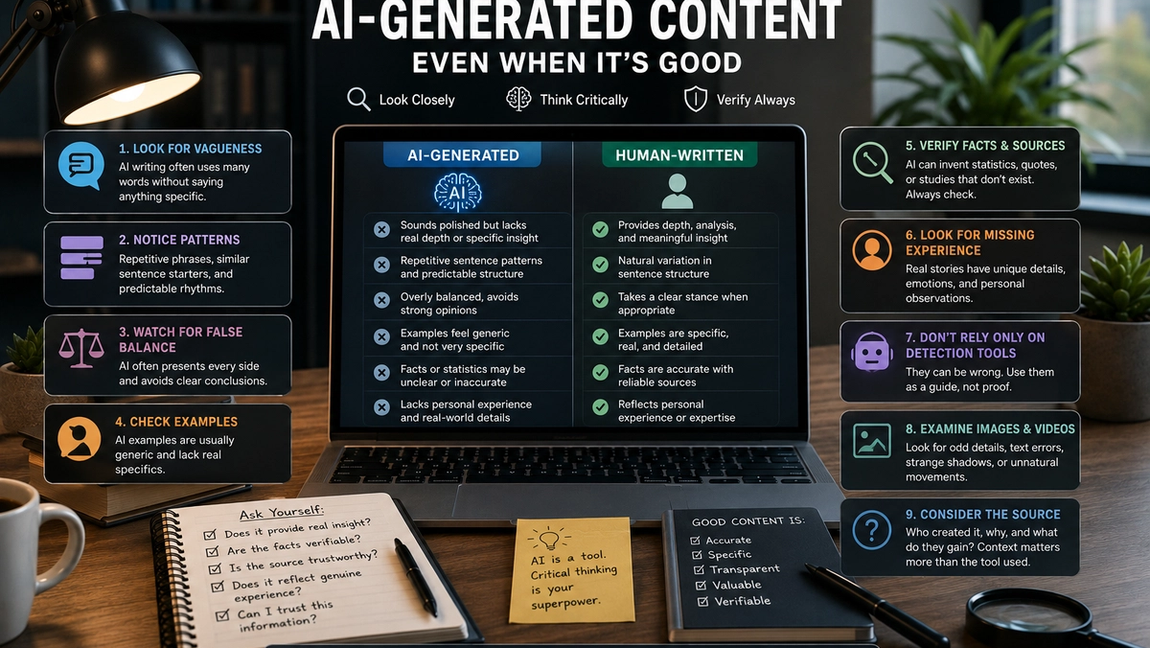
AI-generated content is becoming increasingly difficult to recognize.
Early AI writing often sounded repetitive, overly formal, or strangely unnatural. Today, advanced tools can create articles, emails, social media posts, images, videos, and even realistic voices in seconds. The results can be polished enough to appear completely human at first glance.
That doesn’t mean every piece of smooth or well-organized content was created by AI. People write in different styles, and many human writers naturally use clear structures and polished language.
There is also no single clue that can prove content was generated by artificial intelligence.
Instead, recognizing AI-generated material usually involves noticing several patterns, checking the information carefully, and asking whether the content demonstrates genuine knowledge, experience, or originality.
Look for writing that sounds polished but says very little
AI-generated writing is often grammatically correct and easy to read.
The problem is that it may use many words without providing much specific information.
An article might repeatedly explain that a topic is “important,” “complex,” or “rapidly evolving” without including detailed examples, original analysis, evidence, or practical insight.
The writing sounds professional, but the ideas remain broad.
Human experts often include details that come from experience. They may explain what went wrong during a project, describe an unusual exception, challenge a common assumption, or provide an example that isn’t found in every introductory guide.
AI can imitate expertise, but it may struggle to provide meaningful depth unless it receives strong source material or detailed instructions.
Notice repeated sentence patterns
AI writing often follows predictable rhythms.
Several paragraphs may begin in similar ways. Sentences may repeatedly use structures such as “It’s not only about X—it’s about Y” or “The goal isn’t X. It’s Y.”
These patterns aren’t proof of AI use. Human writers use them too.
However, when the same structures appear throughout an entire article, the writing may begin to feel unusually uniform.
Human writing often contains more natural variation. Some ideas receive detailed explanations, while others are expressed briefly. The tone may shift slightly depending on the subject.
AI-generated content can feel consistently polished in a way that becomes repetitive.
Watch for unnecessary balance
AI systems often try to present every side of an issue.
This can be useful, but it may also make the writing feel overly cautious.
An article may introduce an argument, immediately explain the opposite perspective, and end by saying the best answer depends on individual circumstances.
Sometimes that’s accurate. Other times, the topic requires a clearer conclusion.
Human writers are more likely to express strong opinions, make unusual observations, or argue that one approach is genuinely better.
AI-generated writing may avoid commitment because balanced language is often safer and more broadly acceptable.
Check whether examples feel specific
Examples can reveal a great deal about how content was created.
AI-generated examples are often clear but generic.
A business article may discuss “a small company trying to improve customer service.” A productivity guide may describe “someone managing a busy schedule.” A marketing article may refer to “a brand trying to reach its target audience.”
These examples explain the idea without providing details that make the situation feel real.
Human experiences often contain unexpected specifics: the client changed the deadline, the software failed during a presentation, or a small pricing decision affected customer behavior in an unusual way.
Specificity doesn’t guarantee human authorship because AI can generate detailed examples. However, vague examples combined with other patterns may be worth noticing.
Verify facts, statistics, and sources
One of the most important ways to evaluate AI-generated content is to check its claims.
AI systems can produce information that sounds accurate but isn’t.
They may invent statistics, misrepresent research, confuse dates, create quotations that were never said, or refer to sources that don’t exist.
This is sometimes described as an AI hallucination.
If an article includes a surprising number, study, quotation, or historical claim, search for the original source.
Check whether the research exists, whether the statistic is presented accurately, and whether the information is current.
This is especially important for content involving health, finance, law, politics, science, or safety.
Confident language isn’t evidence of accuracy.
Look for missing personal experience
AI can describe emotions, challenges, and experiences in convincing ways.
However, the writing may still feel slightly distant.
A human writer discussing career change might explain the fear of leaving a specific job, the conversation that changed their mind, or the unexpected difficulty they faced during the transition.
AI may describe the same experience using broader language about uncertainty, growth, and opportunity.
Personal details aren’t required for good writing, and many human-written articles don’t include them.
But when content claims to be based on personal experience while providing no specific memories, observations, or details, it may be worth questioning.
Don’t rely entirely on AI detection tools
Several online tools claim they can identify AI-generated writing.
These tools usually analyze patterns such as predictability, sentence structure, and word choice.
However, their results aren’t always reliable.
Human writing may be incorrectly labeled as AI-generated, particularly when it’s formal, clear, or written by someone using English as an additional language.
AI-generated content may also avoid detection after editing or rewriting.
Detection tools can provide one piece of information, but they shouldn’t be treated as definitive proof.
Making serious academic, professional, or employment decisions based only on an automated score can lead to unfair conclusions.
Images and videos require different clues
AI-generated images have improved dramatically, but they may still contain unusual details.
Look closely at text within the image, reflections, shadows, hands, jewelry, background objects, and repeated patterns.
AI-generated videos may show inconsistent facial movements, unnatural blinking, changing details, or audio that doesn’t perfectly match the speaker’s mouth.
However, these clues are becoming less reliable as the technology improves.
When the source matters, investigate where the content first appeared. Look for the original account, reliable reporting, or additional versions of the same event.
Context is often more useful than visual inspection alone.
Ask who created the content and why
Instead of focusing only on whether something was made with AI, consider the source.
Who published it?
Do they have relevant expertise?
Are sources provided?
Is the information transparent about how it was created?
What does the creator gain if people believe it?
A well-researched article created with some AI assistance may be more reliable than a completely human-written article containing unsupported claims.
The tool used to create content is only one part of evaluating its quality.
Accuracy, transparency, evidence, and accountability matter more.
AI-generated doesn’t automatically mean low quality
AI can help people organize ideas, improve grammar, create outlines, summarize information, and produce first drafts.
Many writers use AI as part of a larger process while still researching, editing, fact-checking, and adding original insight.
The result may contain AI-generated material while still reflecting meaningful human judgment.
The more useful question may not always be, “Was this created by AI?”
It may be, “Can I trust this information?”
Look for evidence, verify important claims, consider the source, and pay attention to whether the content provides genuine insight.
AI-generated content will continue becoming harder to recognize.
Critical thinking is likely to remain more useful than any single detection trick.