The Real Difference Between AI, Machine Learning, and Deep Learning
Artificial intelligence, machine learning, and deep learning are often used as though they mean the same thing. News articles describe new products as “AI-powered.” Technology companies talk about machine learning models. Researchers discuss deep learning systems that can recognize images, generate text, or understand speech.
By Leila Odiaiv on July 13, 2026
Artificial intelligence, machine learning, and deep learning are often used as though they mean the same thing.
News articles describe new products as “AI-powered.” Technology companies talk about machine learning models. Researchers discuss deep learning systems that can recognize images, generate text, or understand speech.
Because these terms are closely connected, the differences can easily become confusing.
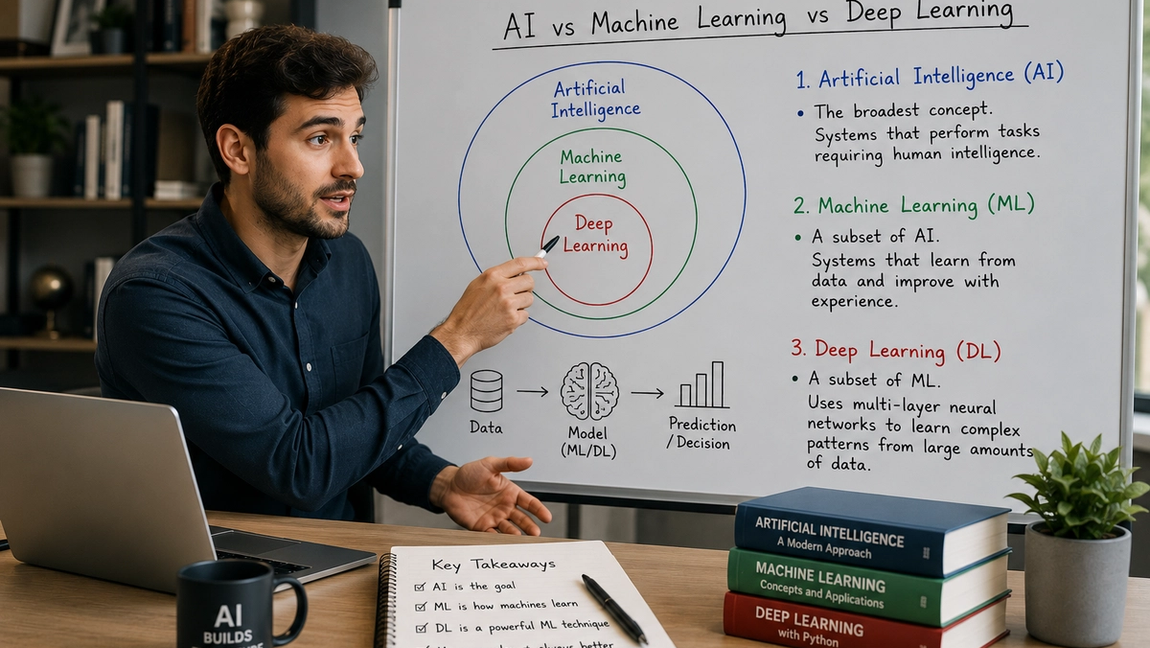
The simplest way to understand them is to imagine three circles inside one another. Artificial intelligence is the largest category. Machine learning is one approach within artificial intelligence. Deep learning is a more specialized type of machine learning.
Each term describes a different level of the same broader field, and understanding how they relate makes modern technology much easier to understand.
Artificial intelligence is the broadest category
Artificial intelligence, commonly called AI, refers to technology designed to perform tasks that usually require some form of human intelligence.
These tasks may include understanding language, recognizing images, solving problems, making predictions, planning actions, generating content, or responding to questions.
AI doesn’t always learn from data.
Some early AI systems were built using detailed rules created by humans. For example, a computer program might be instructed that if a specific condition occurs, it should take a particular action.
A rule-based system can still be considered artificial intelligence because it performs a task that appears intelligent, even though it isn’t learning or improving on its own.
Modern AI often uses machine learning, but the two terms aren’t interchangeable. AI describes the broader goal of creating intelligent behavior, while machine learning describes one way of achieving it.
Machine learning allows systems to learn from data
Machine learning is a branch of artificial intelligence that allows computers to identify patterns in data instead of relying entirely on rules written by programmers.
Imagine trying to create a system that identifies unwanted email.
A traditional rule-based program might be instructed to mark messages containing certain words as spam. The problem is that spam changes constantly, and simple rules may incorrectly block legitimate messages.
A machine learning system can be trained using large numbers of emails that have already been labeled as spam or not spam.
The system analyzes patterns in the examples and learns which characteristics are commonly associated with unwanted messages.
When it receives a new email, it uses those patterns to predict whether the message is likely to be spam.
Machine learning is used in recommendation systems, fraud detection, search engines, medical research, forecasting, translation, and many other applications.
Deep learning uses layered neural networks
Deep learning is a specialized form of machine learning.
It uses artificial neural networks with many layers, which is where the word deep comes from.
These networks are loosely inspired by the way biological neurons connect and process information, although they are much simpler than the human brain.
Each layer learns to recognize different features or patterns.
Imagine a deep learning system trained to identify cats in photographs.
The first layers might detect simple features such as edges, colors, or shapes. Later layers may recognize more complex patterns, including eyes, ears, fur, or faces.
Eventually, the system combines these patterns to predict whether an image contains a cat.
Deep learning is particularly effective when working with large amounts of complex information, such as images, audio, video, and language.
The relationship is easier to understand as a hierarchy
AI, machine learning, and deep learning aren’t competing technologies.
They’re categories within categories.
Artificial intelligence is the broad field focused on creating systems capable of performing intelligent tasks.
Machine learning is a part of AI that uses data to learn patterns and make predictions.
Deep learning is a part of machine learning that uses multi-layered neural networks to learn complex patterns.
This means all deep learning is machine learning, and all machine learning is part of artificial intelligence.
However, not all AI uses machine learning, and not all machine learning uses deep learning.
Understanding this hierarchy helps explain why the terms sometimes appear together while still referring to different concepts.
Traditional machine learning often needs more human guidance
One important difference between traditional machine learning and deep learning is the amount of human involvement required when selecting useful information.
In traditional machine learning, people often decide which features the system should analyze.
For example, when building a model to predict house prices, researchers might select information such as location, property size, number of bedrooms, age, and recent sales in the area.
The model then learns how those features relate to price.
Deep learning systems may learn useful features more automatically from raw data.
Instead of being told exactly which visual details matter in an image, a neural network can learn increasingly complex patterns during training.
This ability can make deep learning powerful, but it often requires much larger amounts of data and computing power.
Deep learning powers many modern AI tools
Many of the AI tools people use today rely heavily on deep learning.
Voice assistants use deep learning to process speech. Image recognition systems use it to identify objects and faces. Translation tools use it to understand relationships between words and languages.
Generative AI systems that create text, images, audio, or video are also commonly built using large neural networks.
These systems learn patterns from enormous amounts of training data and use those patterns to generate new content.
However, learning patterns doesn’t mean understanding information in the same way a person does.
AI systems can produce incorrect information, reflect biases found in data, or generate convincing responses that aren’t accurate.
Their outputs still require human review, particularly when decisions involve health, law, finance, employment, education, or safety.
More advanced doesn’t always mean better
Deep learning receives significant attention because it has enabled major advances in technology.
However, it isn’t the best solution for every problem.
Traditional machine learning models may require less data, use fewer computing resources, and be easier to understand or explain.
For some tasks, a simple rule-based system may be faster, cheaper, and more reliable than a complex AI model.
The appropriate technology depends on the problem, the available data, the required accuracy, the cost, and the importance of understanding how the system reached its decision.
Using the most complicated technology doesn’t automatically produce the best result.
Why the difference matters
Understanding these terms makes it easier to evaluate claims about technology.
When a company describes a product as AI-powered, that could refer to a simple rule-based system, a machine learning model, a deep neural network, or a combination of several technologies.
Knowing the difference helps you ask better questions.
What data was used to train the system? How accurate is it? Can its decisions be explained? What happens when it makes a mistake? How is personal information protected?
The term AI alone doesn’t answer any of those questions.
Different technologies within the same field
Artificial intelligence is the broad goal of creating technology that can perform tasks associated with human intelligence.
Machine learning is a method that allows systems to learn patterns from data.
Deep learning is a type of machine learning that uses layered neural networks to process complex information.
The three concepts are connected, but they aren’t identical.
As AI becomes part of more products, workplaces, and everyday decisions, understanding the language behind the technology is increasingly useful.
You don’t need to understand every mathematical detail to recognize the difference.
Remember the hierarchy: deep learning is part of machine learning, and machine learning is part of artificial intelligence.
That simple relationship explains much of the technology shaping the world today.