The Skills That Will Pay You More for the Rest of Your Career
The skills that help you get your first job aren’t always the same skills that increase your income throughout your career.
By Kate Willis on July 13, 2026
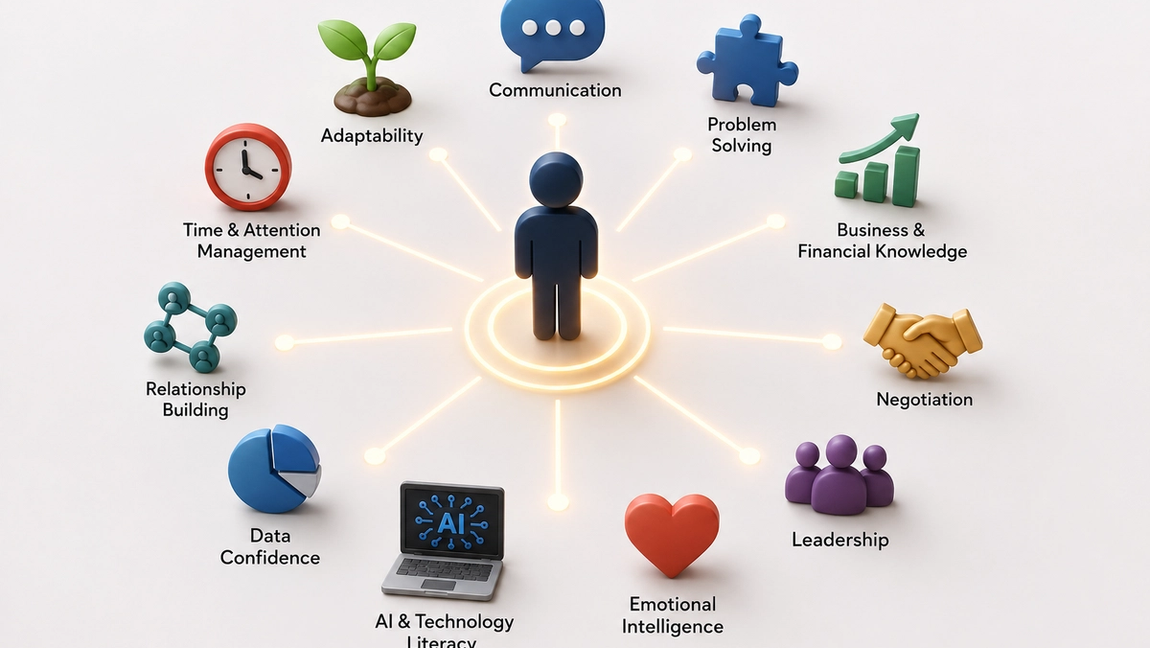
The skills that help you get your first job aren’t always the same skills that increase your income throughout your career.
Technical knowledge matters. Qualifications matter. Experience matters. But as people move into more senior roles, their earning potential often depends on a broader set of abilities: communicating clearly, solving valuable problems, making good decisions, leading others, and adapting when industries change.
Some skills become outdated as technology evolves. Others become more valuable because they can be applied across different roles, companies, and industries.
The most useful career skills aren’t connected to one job title. They continue creating opportunities even when your work changes.
Learn how to communicate clearly
Strong communication is valuable in almost every career.
The ability to explain an idea clearly can help you lead meetings, write stronger proposals, manage projects, work with clients, influence decisions, and avoid misunderstandings.
Communication isn’t about using complicated language or speaking more than everyone else. It’s about helping people understand what matters.
This includes knowing how to adjust your message for different audiences. A technical team may need detailed information, while senior leaders may want a clear explanation of the business impact.
Written communication is equally important. Professionals who can write clear emails, reports, presentations, and recommendations often save time for everyone around them.
As responsibilities increase, communication becomes more valuable because your work depends increasingly on your ability to create understanding and alignment.
Become comfortable solving difficult problems
Organizations pay people to solve problems.
The more important, expensive, or complicated the problem is, the more valuable the ability to solve it may become.
Strong problem-solvers don’t immediately accept the first explanation. They ask questions, examine evidence, identify the underlying cause, and consider several possible solutions.
They also understand that solving the wrong problem wastes time.
For example, declining sales may appear to be a marketing issue, but the real cause could be poor customer retention, unclear pricing, or a product that no longer meets customer needs.
Developing problem-solving skills means learning to look beyond symptoms and understand what is actually happening.
People who can reduce costs, improve results, remove obstacles, or create better systems often become valuable in almost any organization.
Build financial and business knowledge
You don’t need to work in finance to understand how money affects a business.
Learning the basics of revenue, profit, costs, budgets, pricing, cash flow, and return on investment can improve the way you make decisions.
When you understand how an organization creates value, you can connect your work to outcomes that leaders care about.
Instead of explaining only what you completed, you can describe how your work increased revenue, reduced expenses, improved efficiency, lowered risk, or supported growth.
Business knowledge also helps you evaluate career opportunities.
You may become better at understanding whether a company is growing sustainably, whether a project is financially realistic, or whether your own compensation reflects the value you provide.
The ability to connect your work with business results can make your contribution easier to recognize.
Learn how to negotiate
Negotiation affects much more than salary.
You negotiate deadlines, responsibilities, budgets, project priorities, resources, job offers, promotions, contracts, and working arrangements.
People who avoid negotiation may accept conditions that don’t reflect their value or needs.
Effective negotiation isn’t about being aggressive.
It’s about understanding what matters to both sides, preparing evidence, communicating clearly, and looking for an agreement that creates value.
The ability to negotiate compensation can have a long-term effect on earnings because future raises may be based partly on your current salary.
Even small improvements can become significant over several years.
Learning to discuss money and professional expectations confidently is one of the most practical career skills you can develop.
Develop leadership before you have a leadership title
Leadership isn’t limited to managers.
People demonstrate leadership when they take responsibility, support colleagues, solve problems, communicate direction, and help a group move toward a shared goal.
You don’t need direct reports to build these skills.
You can lead a project, mentor a new employee, improve a process, organize information, or take responsibility when a team faces uncertainty.
Strong leaders don’t simply tell people what to do.
They create clarity, make thoughtful decisions, listen carefully, and help others perform well.
As careers progress, organizations often pay more for the ability to improve the work of an entire team rather than only complete individual tasks.
Leadership increases your impact because your contribution extends beyond your own workload.
Improve your emotional intelligence
Technical expertise may help you qualify for a role, but emotional intelligence often affects how successfully you work with others.
Emotional intelligence includes recognizing emotions, managing your reactions, understanding different perspectives, communicating during conflict, and responding thoughtfully under pressure.
Workplaces involve people with different personalities, priorities, communication styles, and expectations.
The ability to navigate those differences can make you a stronger colleague and leader.
Emotionally intelligent professionals don’t avoid difficult conversations. They learn how to approach them without creating unnecessary conflict.
They can give feedback clearly, receive criticism without becoming defensive, and remain calm when situations become stressful.
These abilities become increasingly valuable in roles involving leadership, clients, partnerships, or complex teamwork.
Learn to use AI and technology effectively
Technology continues changing the way people work.
You don’t need to become a software engineer, but understanding how to use modern tools can improve your productivity and make your skills more relevant.
AI can help organize information, create first drafts, analyze data, summarize documents, automate repetitive work, and support research.
The most valuable skill isn’t simply knowing how to use one AI platform.
Tools will change.
What’s more important is learning how to identify useful applications, write clear instructions, evaluate outputs, protect sensitive information, and combine technology with human judgment.
People who use AI effectively may be able to complete routine work faster and spend more time on strategy, creativity, relationships, and decision-making.
Technology is most valuable when it strengthens your expertise rather than replacing your thinking.
Become confident working with data
Many organizations collect more information than they know how to use.
People who can understand data and turn it into useful decisions are valuable across industries.
Data skills don’t always require advanced mathematics or programming.
They may involve understanding spreadsheets, interpreting charts, identifying trends, asking the right questions, and recognizing when numbers are being presented without important context.
The ability to explain what data means can be just as important as analyzing it.
Leaders rarely need another complicated dashboard.
They need someone who can explain what is happening, why it matters, and what the organization should consider doing next.
Build relationships before you need them
Professional relationships can create opportunities that qualifications alone may not provide.
A strong network can introduce you to new roles, clients, mentors, partnerships, ideas, and industries.
Networking doesn’t have to mean attending events and asking strangers for opportunities.
It can involve staying in contact with former colleagues, helping people when you can, sharing useful information, and showing genuine interest in the work of others.
Strong professional relationships are built over time.
People are more likely to recommend someone they trust, respect, and remember positively.
Your reputation often travels further than your resume.
Being reliable, thoughtful, helpful, and professional can create opportunities years after you first work with someone.
Learn how to manage your time and attention
Being busy isn’t the same as creating value.
Many professionals spend their days responding to messages, attending meetings, and completing urgent tasks without making progress on the work that matters most.
Time management isn’t only about fitting more tasks into the day.
It’s about deciding which work deserves your attention.
This may involve setting priorities, protecting time for focused work, creating boundaries, delegating when appropriate, and recognizing which tasks don’t need to be completed at all.
As your career grows, your attention becomes more valuable.
The ability to focus on high-impact work can improve both your performance and your opportunities.
Adapt without constantly starting over
Industries change.
New technologies appear, customer expectations evolve, and some skills become less valuable.
Adaptability doesn’t mean following every trend or changing direction every few months.
It means being willing to learn, update your knowledge, question old methods, and respond when circumstances change.
The most resilient professionals build skills that can transfer between different roles.
Communication, leadership, problem-solving, business knowledge, and decision-making remain useful even when tools and industries evolve.
Adaptability allows you to change without losing the value of everything you’ve already learned.
Build skills that increase your impact
Higher income is rarely connected to one ability alone.
It often comes from combining several valuable skills.
A technical expert who communicates clearly may become a strong leader. A creative professional who understands business may build a successful company. A manager who understands data may make better strategic decisions.
The most valuable skills increase the impact of everything else you know.
You don’t need to master all of them at once.
Choose one skill that would make the biggest difference in your current role and practice it consistently.
Over time, strong communication, problem-solving, leadership, negotiation, business knowledge, emotional intelligence, and adaptability can create opportunities across an entire career.
Jobs will change. Technology will change. Industries will change.
Skills that help you understand problems, work well with people, make better decisions, and create measurable value are likely to remain useful wherever your career takes you.